Spades: Classic Card Games
- 4.7
- Rating
- 10.00M
- Installs
- Free
- Price
 Analysis by App-foxy
I enjoy card games most when they are easy to start but difficult to play perfectly. Spades: Classic Card Games fits that space well. It is a free card game from MobilityWare built around the familiar trick-taking rules of Spades, yet its appeal is less about flashy presentation and more about the small decisions that keep pulling me into another hand. I can open it during a short break, make a few careful bids and plays, finish a round, and decide whether I have enough time for one more.
The basic idea is simple: I estimate how many tricks I can take, choose cards with a plan, and try to coordinate my play with the changing table. That simplicity makes the game approachable, while the partnership element gives every card more meaning than it first appears to have. A high card can be useful, dangerous, or completely wasted depending on when it is played.
This is a card game for people who want a recognizable classic rather than a large collection of unrelated systems. It is free to install, rated for Everyone, and available on devices running Android 8.0 or later. The current version is 2.7.1.5344, and the game has attracted over 10 million installs. Those figures suggest a well-established audience, but the real question is whether its particular rhythm suits the way you like to play.
You May Also Like

 Pandora - Music & Podcasts
Pandora’s Music Is Easy to Start, but Harder to Recover
Pandora’s strength is its low-effort path from a seed to a station. Its weak spot is how much confidence it asks you to place in connection, setup, and quiet recovery.

 8 Ball Pool
 Is Built on Rivalries, Rematches, and Routine
A close look at the rivalries, rematches, shared routines, and unanswered safety questions that turn a quick pool match into a persistent mobile community.

 Samsung Music
’s Quiet Strength Is Playing What You Already Own
Its reach comes less from spectacle than from dependable access to a personal library. That simplicity is both the app’s strongest retention engine and its ceiling.

 AccuWeather: Weather Radar
AccuWeather Review: A Quick, Clear Forecast for Everyday Decisions
For everyday plans, the best forecast is the one you can understand quickly. AccuWeather makes rain timing, radar, and local conditions easy to act on, with a few trade-offs.

 Hill Climb Racing
Why Hill Climb Racing Still Turns Crashes Into One More Run
A tiny car, a bumpy hill and one more upgrade: Hill Climb Racing keeps resurfacing because its simple chaos makes every near-miss feel personal.

 AliExpress - Shopping App
AliExpress Makes Global Shopping Feel Personal, but Shoppers Bear the Risk
AliExpress turns a global marketplace into a pocket-sized discovery engine. Its reach is useful, its shopping loop compelling, and its trade-offs easy to miss.
More From Our News Desk
View All News


How the first hand gets me playing
The first useful action is not tapping through a complicated menu; it is looking at the cards and deciding what the hand might be worth. The bidding stage gives me an immediate problem to solve. I have to judge my strong suits, count likely winners, notice whether spades can change the situation, and avoid promising more tricks than the hand can realistically deliver.
That opening decision is where the game becomes more interesting than a basic high-card contest. A hand with several powerful cards may still be awkward if the suits do not cooperate. Conversely, a modest-looking hand can become valuable when I can create an opportunity to use spades at the right moment. I like that the game asks me to commit before I know exactly how the table will unfold.
For someone new to Spades, the rules are approachable, but the strategy is not instantly obvious. I found the best way to learn was to treat early rounds as practice in observation rather than trying to win every trick. I pay attention to which suits opponents can still follow, which high cards have already appeared, and whether my partner seems to be protecting a particular plan.
The first action also changes depending on my mood. If I am playing casually, I can make a quick estimate and let the hand teach me what I missed. If I want to improve, I slow down before bidding and ask three practical questions: how many tricks can I take without using spades, which cards might force an opponent to spend a stronger card, and what happens if my partner wins the lead?
That last question is especially important. A bid is not only a prediction of my own cards; it is a promise made within a partnership. Overbidding can leave the team chasing tricks that are not there, while underbidding can waste a hand with more potential than I recognized. The game rewards players who think about the whole table instead of treating every card as an isolated move.
Why the controls matter more than decoration
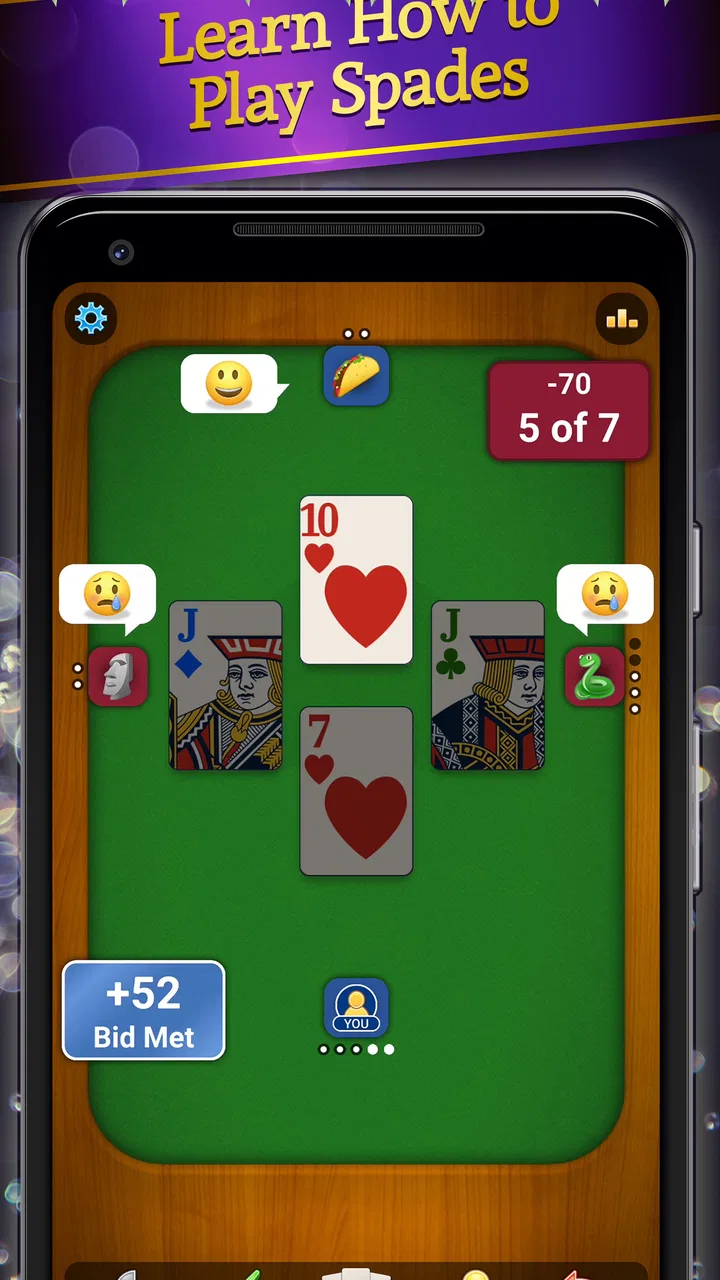
In a trick-taking game, the interface should stay out of the way. I want to see the cards clearly, understand whose turn it is, and select a legal play without hesitation. Spades: Classic Card Games works best when I am focused on the table rather than searching for controls. That makes it suitable for short sessions, especially when I do not want to learn a new control scheme before playing.
There is also a practical advantage to a straightforward card layout: I can concentrate on memory. I mentally separate suits that have already been exhausted from suits that may still force a player to follow. This is not a feature that announces itself, but it is one of the reasons the game can become more absorbing after the rules feel familiar. The less attention I spend on navigation, the more attention I can spend on card counting.
Still, players who expect a deep campaign, elaborate customization, or a constantly changing visual experience may find the presentation restrained. This is a focused card table, not an adventure game with a long progression system. I see that as a strength for quick play, but it also defines the audience clearly.
The feedback rhythm: every trick changes the next one
The most satisfying part of a hand is the feedback loop after each trick. I play a card, watch the other cards arrive, and immediately learn something about the remaining possibilities. A suit may be nearly empty. A dangerous high card may be gone. My partner may have taken control, or an opponent may have revealed that they are short in a suit and can now use spades.
That rhythm gives the game its steady tension. The action is small, but the information keeps accumulating. A trick is not merely a point on the scoreboard; it changes what I believe about the next trick. When I lose a card I expected to win, I have to revise my plan rather than simply wait for the next deal.
I particularly enjoy the moments when a deliberately low card produces useful information. Playing low can reveal who is forced to follow, preserve a stronger card for later, or allow my partner to win without spending an important resource. New players often focus on taking tricks immediately, but the better question is whether winning now helps the team finish the hand.
One practical habit improved my play: I stopped judging a card only by its rank. Before playing, I consider whether the card changes the lead, protects my partner, or removes an opponent’s chance to control the next trick. A medium card can be more valuable than a high one if it keeps the hand moving in the direction I need.
The game also makes mistakes easy to understand after the fact. If I bid too aggressively, the failed contract is a clear signal that my initial estimate was wrong. If I lose control late in the hand, I can usually trace the problem to an earlier decision: perhaps I spent a spade too soon, failed to track a suit, or assumed my partner had a card they never showed.
That clarity is useful for casual players and serious learners alike. I do not need a long tutorial to identify every mistake. The hand itself provides the explanation, provided I take a moment to replay the sequence mentally. This is one of the strongest reasons I would recommend the game to someone who wants to become better at Spades rather than simply pass time.
Playing with a partner instead of playing alone
Partnership play creates a second layer of feedback. I have to interpret what my partner’s choices might mean without direct conversation. A partner who wins a trick with a particular card may be protecting a suit, trying to regain the lead, or simply responding to the cards available. I cannot always know the intention, so I work with probabilities and adjust as new cards appear.
This can be rewarding, but it can also be frustrating. When a partner makes a move I would not choose, I have to avoid treating the hand as lost. The best response is to preserve flexibility. I look for ways to support the likely plan rather than forcing my original idea through every trick.
That makes the game a good fit for players who enjoy quiet deduction. It is less suitable for anyone who dislikes uncertainty caused by a partner or wants complete control over every outcome. Even excellent decisions cannot guarantee a win when the deal and the table do not cooperate.
The feedback is also why repeated sessions do not feel identical to me. The rules stay stable, but my reading of the table changes. One hand teaches me to protect a suit; another reminds me that keeping the lead can matter more than taking an extra trick. The game’s variety comes from decisions inside the same framework rather than from constantly adding new mechanics.
What counts as a reward when the game stays simple
The main reward is not a dramatic unlock or a complicated collection. It is the feeling that a hand came together because I read it correctly. Making a careful bid, allowing an opponent to spend a powerful card, and then taking the critical trick later feels earned. The reward is a cleaner plan and the knowledge that I handled the table better than I did in the previous attempt.
That kind of reward suits the classic-card-game format. I can finish a hand with a win, but I can also learn from a loss. If I correctly identify why a bid failed, the next session still has value. The game encourages improvement through repetition because the rules are stable enough for patterns to become visible.
There is a useful distinction between winning a trick and gaining control. Sometimes I take a trick that leaves me with an awkward lead, while another play would have allowed my partner to control the next exchange. The more I play, the more I value the second outcome. This is a non-obvious strength of the design: it rewards timing and restraint, not just aggressive card use.
I also find the short-hand structure convenient. A complete session can fit into a break, but I do not feel forced to make every decision instantly. That makes it practical for relaxed solo play at home, a commute with enough uninterrupted time, or a quiet evening when I want something interactive without the demands of a larger game.
Because the game is free, it is easy to try without committing money upfront. There are in-app purchases ranging from $4.99 to $29.99 per item, so anyone who prefers a completely purchase-free experience should keep that in mind before spending time with it. I would approach those options carefully and decide whether the basic play already gives me what I want before considering any optional purchase.
The average rating is 4.7 from around 196 thousand ratings, with roughly 15 thousand written reviews. I do not treat popularity as proof that every player will enjoy it, but it does match my impression that the game serves its central purpose well: it provides a familiar Spades experience that is easy to return to.
Who gets the most from the reward loop
I would recommend it to someone who already knows Spades and wants a convenient digital table, as well as to a beginner willing to learn through repeated hands. It is also a good choice for players who like analyzing probabilities, remembering played suits, and improving one decision at a time.
I would be more cautious about recommending it to someone seeking a broad card-game bundle. The store summary presents classic card games, but the short description identifies the experience as Spades, so I would install it specifically for Spades rather than assuming it replaces every other card game. If I wanted solitaire-style relaxation, a collectible-card battle, or a fast arcade card game, I would choose a different category instead.
It may also disappoint players who need a strong social atmosphere around every match. The partnership format creates social-style decision-making, but the appeal comes from reading cards and managing a hand, not from building a large community around the table. For me, that keeps the experience focused; for someone wanting constant interaction, it may feel quiet.
The reset: why I deal another hand
Every hand eventually ends, and that reset is central to the game’s appeal. A poor bid does not permanently damage the next deal. A missed opportunity becomes a lesson, while a successful sequence becomes something I try to reproduce under different conditions. The reset gives me permission to experiment without making one mistake feel final.
My usual everyday scenario is a short wait when I have enough time for concentration but not enough time to begin a larger game. I open the app, review the hand, make a bid, and play through the changing table. If I lose because I misread the distribution, I am often tempted to start again immediately—not because the game pressures me, but because the next deal gives me a fresh chance to apply what I just noticed.
The reset is especially valuable after a close hand. A narrow loss can leave me thinking about one decision: should I have saved a spade, bid one trick lower, or led a different suit? Starting again lets me test that lesson. The game becomes a small cycle of hypothesis, action, result, and adjustment.
There is a trade-off here. Players who prefer a strong sense of permanent progression may find the reset too clean. Classic Spades does not need a dramatic long-term structure to work, but that also means the motivation comes from mastery and replay rather than from collecting a large number of persistent rewards. I enjoy that honesty, though I understand why another player might want more variety between sessions.
The reset also makes the game forgiving for beginners. I can try a conservative bid in one hand, take more risks in the next, and gradually learn which choices fit my style. A beginner should not worry about playing perfectly from the start. The most useful early goal is to identify why a trick was won or lost and carry that observation into the next deal.
Small habits that make later sessions better
I recommend tracking the suits mentally instead of focusing only on the score. When a suit disappears from a player’s hand, that player may gain an opportunity to use spades. Recognizing that possibility before it happens helps me avoid leading a suit that gives an opponent an easy advantage.
I also avoid spending every strong card as soon as possible. Holding one useful card can preserve control when the hand reaches its final tricks. This is particularly important when my bid is already close to being met; taking an unnecessary extra trick may create a new problem rather than solve the current one.
Another helpful habit is to separate a failed result from a bad decision. Sometimes the correct play still loses because the cards do not cooperate. If I judge every loss as proof that I played badly, I learn the wrong lesson. I ask whether the decision was sensible with the information available at the time. That mindset keeps the reset productive instead of turning it into repetitive frustration.
Finally, I treat the partner’s play as information. Even when I disagree with a move, it tells me something about the cards still in circulation. Watching those choices closely is more useful than trying to predict every move in advance. The game rewards adaptation more than stubbornly following a plan made at the beginning of the hand.
My verdict on the complete loop
The loop is clear and satisfying: I inspect a hand, make a bid, play each trick, receive immediate information from the table, earn the result of my decisions, and then face a new deal with a slightly better understanding of the game. That action-feedback-reward-reset pattern is exactly why I keep returning. The next session begins because the previous one leaves behind a question I want to answer.
MobilityWare has kept the focus on the classic Spades experience, and that focus is both the game’s strongest quality and its main limitation. I get a familiar card-table challenge without needing to learn a large system. In exchange, I should not expect the breadth of a general card-game collection or the constant novelty of a more elaborate genre.
The free entry point makes trying it straightforward, while the Everyone age rating keeps it suitable for a broad audience. The current version supports devices from Android 8.0 onward, and the established player base makes it feel like a dependable choice rather than an obscure experiment. I would still remember that optional in-app purchases are available and avoid assuming that every part of the experience must appeal to me simply because the rating is strong.
Compared with a physical deck, the app is more convenient and easier to start, but it removes some of the atmosphere of sitting across from real people. Compared with a generic solitaire game, it offers more strategic interaction because every trick involves opponents and a partner. Compared with a collectible or competitive card battler, it is calmer, more traditional, and less dependent on building a specialized collection.
My recommendation is simple: choose it if you want thoughtful Spades in compact sessions, and skip it if you need constant novelty, deep customization, or a different kind of card challenge. I like it because the rules remain familiar while the decisions keep changing. One hand can be casual, the next can expose a mistake in my bidding, and the one after that can reward patience. That is enough to make the reset feel worthwhile and another session feel like a genuine opportunity rather than mere repetition.
FAQs for Spades: Classic Card Games
01What are the main features of Spades: Classic Card Games?
Spades: Classic Card Games offers a variety of features that enhance the traditional card game experience. It includes customizable difficulty levels, multiplayer support, and unique themes. The game also provides a tutorial for beginners, ensuring everyone can enjoy and master the game. Additionally, it allows both online and offline play, catering to all types of players.
02Is Spades: Classic Card Games available for both Android and iOS?
Yes, Spades: Classic Card Games is available for both Android and iOS platforms. You can download it from the Google Play Store for Android devices and the Apple App Store for iOS devices. This cross-platform availability ensures that players can enjoy the game on a wide range of devices.
03Does Spades: Classic Card Games require an internet connection to play?
Spades: Classic Card Games can be played both online and offline. While an internet connection is required for multiplayer functionality and online leaderboards, the game also offers offline modes. This allows players to enjoy the game without interruption, regardless of their internet connectivity.
04Are there in-app purchases in Spades: Classic Card Games?
Yes, Spades: Classic Card Games includes in-app purchases. These purchases typically offer additional themes, card designs, and other cosmetic enhancements. However, the core gameplay remains free, allowing players to enjoy the full game experience without spending money if they choose not to.
05How does the multiplayer mode work in Spades: Classic Card Games?
The multiplayer mode in Spades: Classic Card Games allows players to connect with friends or compete against other players worldwide. You can create private games with friends or join public matches. The game’s matchmaking system ensures fair play by pairing players of similar skill levels, enhancing the competitive experience.
Pros
- Engaging multiplayer mode enhances social play.
- Smooth graphics and intuitive design.
- Customizable game rules for varied play.
- Offline mode for uninterrupted gaming.
- Regular updates with new features.
Cons
- Occasional ads disrupt gameplay flow.
- Limited tutorials for beginners.
- In-app purchases can be pricey.
- Some connectivity issues in multiplayer.
- No chat feature for in-game communication.

Spades: Classic Card Games
Gallery